Home
“Best Research Environment 2026”: 15 teams shortlisted
Press Release

Die Junge Akademie and the Volkswagen Foundation are recognising exemplary research environments for the second time / Prize money to be awarded to five of the 15 teams
- Projects
- Topics
A good research environment is crucial for successful science. To highlight how teams create fair, inspiring and performance-enhancing conditions, Die Junge Akademie and the Volkswagen Foundation are presenting the “Best Research Environment” award for the second time.
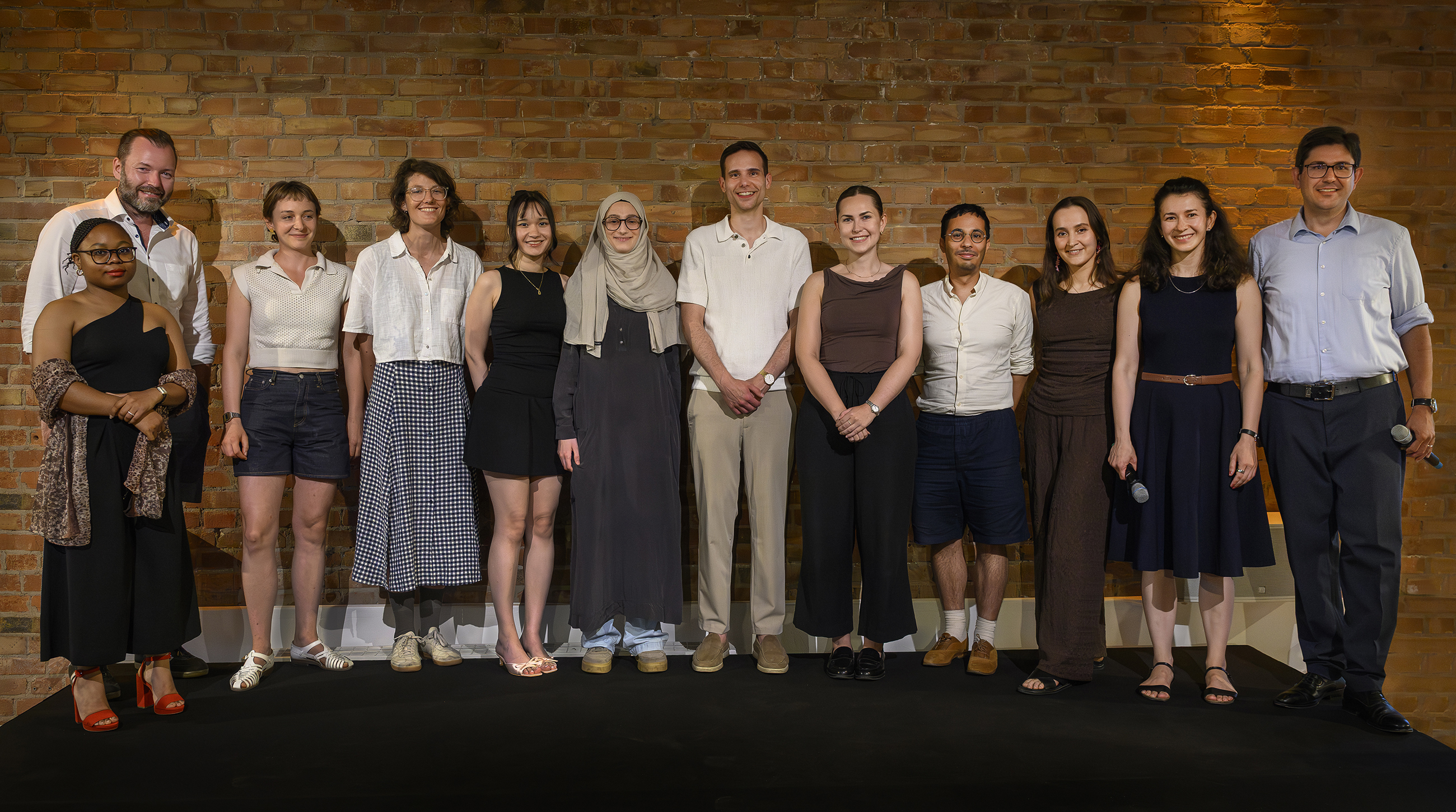
Fifteen teams from various disciplines were shortlisted for this year’s award. They embody a research culture that combines scientific excellence with respectful collaboration, open communication and reliable support. On 27 June, at Die Junge Akademie’s annual celebration, five teams each received prize money of 10,000 euros. As all 15 teams were equally deserving of the prize, the prize money was awarded by lottery. Representatives from all teams travelled to Berlin to take part in the draw and expand their networks.
“The teams on the shortlist impressively demonstrate that good research environments are not a matter of chance, but the result of deliberate design. They create conditions in which scientific excellence is made possible, alongside mutual support, guidance and development,” said Hani Harb, a member of Die Junge Akademie’s Board and an infectious disease immunologist at Dresden University Hospital.
“Excellent research does not arise solely from individual achievements, but rather where people work together to create an environment that fosters openness, creativity and development. The shortlist for the second round of the competition illustrates in a unique way just how diverse such research environments can be today,” emphasises Georg Schütte, CEO of the Volkswagen Foundation.
-
These 15 teams have been awarded the “Best Research Environment 2026” prize. The top five teams were each awarded prize money of 10,000 euros:
In selecting the teams for the shortlist, the panel recognised, among other things, a clear sense of purpose, transparent responsibilities and communication channels, an open culture of learning from mistakes, and reliable support structures. From over 170 applications, the jury selected 15 teams for the shortlist – a choice that was by no means easy. The second round of the competition demonstrated once again that numerous research environments beyond the shortlist also offer excellent structures.
Shortlist featuring all 15 teams
Information on the prize, selection criteria and funding conditions
Background information
Die Junge Akademie is the world’s first academy for researchers in the early and mid-stages of their careers and, in the nearly 25 years of its existence, has developed into an important voice within the German research system. The Volkswagen Foundation was involved in the establishment of Die Junge Akademie through financial support until 2005. With its profile area “Understanding Research”, the Volkswagen Foundation opens up spaces for reflection and supports structural changes in the science system. One thematic focus is on the diversity of scientific culture(s).
Die Junge Akademie was founded in 2000 as the world’s first academy for outstanding young academics. Its members – who come from all academic disciplines as well as creative fields – explore the potential and limits of interdisciplinary work in new projects, aim to encourage dialogue between academia and society, and provide new impetus in discussions about scientific policy. Die Junge Akademie is supported by the Berlin-Brandenburg Academy of Sciences and Humanities (BBAW) and the German National Academy of Sciences Leopoldina. Its office is located in Berlin.
Contact
Die Junge Akademie
Anne Rohloff
Phone +49 30-241899-106
press@diejungeakademie.de
www.diejungeakademie.de/en
participating Members
-
-
Hani Harb
- person_research_subject
- Infectious Immunology
- institution
- Dresden University of Technology
- Phone
- +49 351 458-11893
- hani.harb@ukdd.de
-
Sarah Klosterkamp
- person_research_subject
- Human Geography
- institution
- Goethe University Frankfurt
- Phone
- +49 69 798 35176
- klosterkamp@geo.uni-frankfurt.de
-


participating Alumnae / Alumni
-
-
Christopher Degelmann
- person_research_subject
- Ancient History
- institution
- Humboldt-Universität zu Berlin
- Phone
- +49 30 2093-70511
- christopher.degelmann@hu-berlin.de
-
Gisela Kopp
- person_research_subject
- Biology
- institution
- Max Planck Institute of Animal Behavior
- Phone
- +49 7531 88-5657
- gkopp@ab.mpg.de
-


more press realeses
-
-
“Best Research Environment 2024”: Winning teams announced
Die Junge Akademie and the Volkswagen Foundation honour ten outstanding teams with the inaugural “Best Research Environment” award
Topics:
- date
- 08.06.25
-
We are looking for: best research environment 2026!
Die Junge Akademie and the Volkswagen Foundation are once again jointly offering the prize for the best research environment in 2026 | Applications possible until 1 March 2026
Topics:
- date
- 16.01.26
-
We are looking for: best research environment 2024!
Die Junge Akademie and the Volkswagen Foundation are this year launching the inaugural award for the best research environment. Applications can be made until 18 November 2024. The winning teams will each receive 10,000 euros.
Topics:
- date
- 01.10.24
-